
Request Mocking Protocol
Request Mocking Protocol (RMP) is a specification for network requests mocking in end-to-end tests. It uses declarative JSON schemas to define mocked request and response. These schemas can be serialized and sent over the network, enabling both server-side and client-side mocking.
Server-Side Mocking
RMP lets you mock API calls made by your application server. Here's how it works:
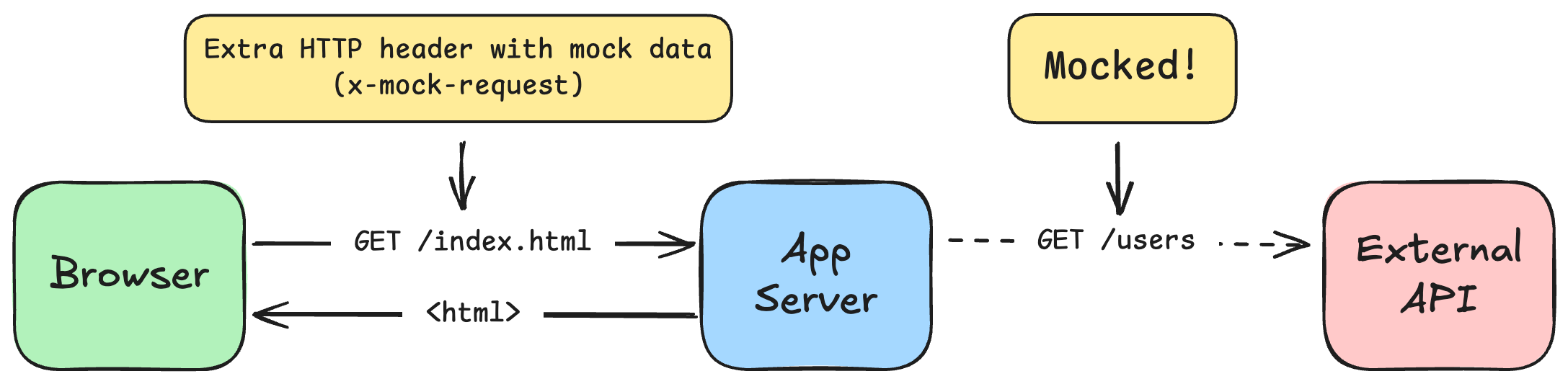
- A test defines mock schemas and sends them to the app server in a custom HTTP header:
x-mock-request. - The server-side interceptor reads that header and applies the mocks to the outgoing API calls.
- The page is rendered with mocked data, and the test can assert the expected UI state.
This is ideal for server-side rendered pages, where data is fetched on the server before the page reaches the browser. Learn how to set it up in Server-Side Mocking →
Client-Side Mocking
RMP also lets you mock requests made directly in the browser, using the same declarative schemas. It works with any framework, no special integration needed.
This is ideal for single-page apps and any data fetched on the client. Learn how to set it up in Client-Side Mocking →
Ready to try it out? Head over to Installation to get started, or dive into the Concepts to learn more.